Body Scan Meditation: A Step-by-Step Guide
How to do a body scan meditation, part by part, in ten minutes or less—with modifications for pain, restlessness, and a mind that will not settle.
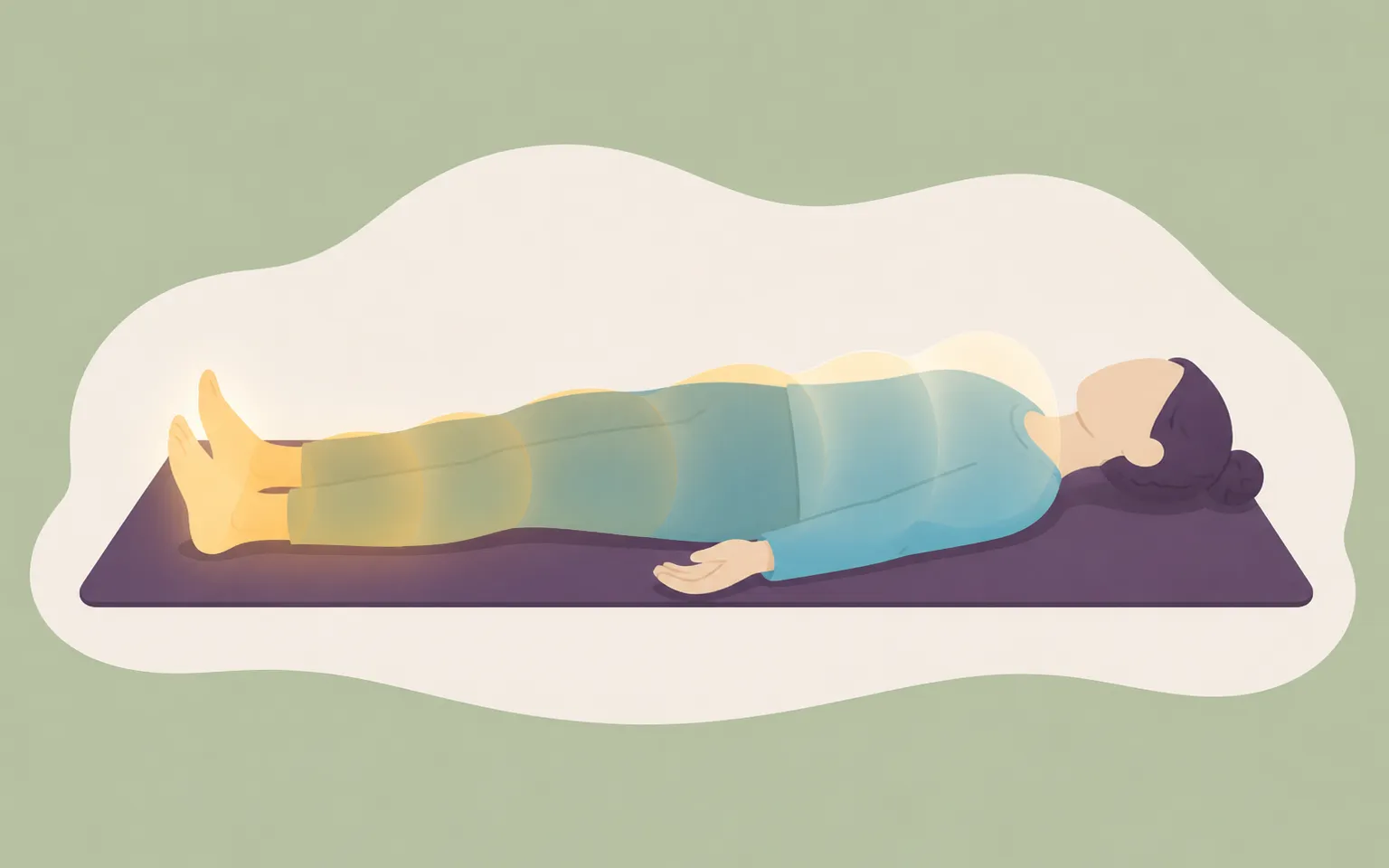
Most of us spend the day from the neck up. We think, plan, read, and reply, and the body carries us around underneath all of it, sending signals we mostly do not read—until the shoulder that has been tight since Tuesday finally insists.
A body scan is the practice of reading those signals on purpose. You move your attention slowly through the body, part by part, noticing what is there without trying to change it. It takes as long as you have, and it is one of the few practices that works just as well lying down.
What is a body scan meditation?
A body scan meditation is a practice in which you move your attention systematically through the body—usually from the feet upward—noticing sensation in each area without judging it or trying to fix it. It is a core exercise in mindfulness-based stress reduction and is commonly used to build body awareness and release unnoticed tension.
The word scan is slightly misleading. You are not inspecting yourself for problems. You are visiting each area briefly and letting whatever is there be there.
The practice was formalized as part of the mindfulness-based stress reduction program developed at the University of Massachusetts Medical School in 1979, which is where most modern versions come from. For a measured overview of what meditation research does and does not show, the National Center for Complementary and Integrative Health is a reliable reference.
How to do a body scan, step by step
Set aside ten minutes. Lie on your back if you can—on a bed, a mat, the floor—or sit with your back supported. Let your hands rest apart from your body and your legs uncrossed.
- Arrive first. Take three unhurried breaths and feel the surface underneath you: heels, hips, shoulder blades, the back of the head. Notice where your weight actually lands.
- Start at the left foot. Bring attention to the sole, then the toes, the top of the foot, the ankle. Ask what is present—warmth, pressure, tingling, nothing at all—and accept the answer.
- Move up the left leg. Calf, shin, knee, thigh. Spend perhaps fifteen seconds on each area. There is no need to hurry, and no need to linger.
- Repeat on the right side. Right foot, right leg, same pace.
- Cross the pelvis and lower back. These often hold more than we expect. Notice without commentary.
- The belly and chest. Let the breath move here on its own. You are watching it, not managing it.
- Both hands and arms. Fingertips, palms, wrists, forearms, elbows, upper arms, shoulders. The shoulders are worth an extra breath.
- Neck, jaw, and face. The jaw, the space between the eyebrows, the muscles around the eyes, the scalp. A great deal of held tension lives in this small area.
- Finish with the whole body at once. Instead of parts, hold a sense of the entire body lying there, breathing. Stay for a few breaths.
- Leave slowly. Move your fingers, open your eyes, and take a moment before standing up.
When you notice you have drifted off into thought—and you will, several times—return to wherever you left off. Or start the current area again. Nothing has gone wrong.
A shorter sequence for restless days
If ten minutes is not available, or lying still feels impossible, use six areas instead of twenty: feet, legs, torso, hands and arms, shoulders and neck, face. Three breaths each. That is roughly three minutes, and it is a real practice rather than a compromise.
What you are actually practicing
It is easy to assume the goal is relaxation. It often happens, and it is a welcome side effect, but it is not the skill being built.
The skill is noticing sensation without immediately reacting to it. Tension arrives, you register it, and you do not add a story about what it means or a project to eliminate it. That sounds modest. In practice it is the foundation of catching a stress response early enough to do something about it—hours before the tight shoulder becomes a headache.
There is a second, quieter benefit. A body scan gives attention a route to follow. For a mind that will not settle, having somewhere specific to go next is easier than being told to concentrate. If that is your usual difficulty, a practice for a scattered mind approaches the same problem from a different angle.
Common difficulties, and what to do
“I do not feel anything.” Then nothing is the observation, and it is a valid one. Numb or blank areas are extremely common, particularly in the middle of the back and the upper arms. Note the absence and move on. Manufacturing a sensation is not the exercise.
“I keep falling asleep.” This usually means you are tired, which is worth knowing. If you want to stay awake, sit up rather than lie down, and try it earlier in the day. If you want to fall asleep, this is a feature—see the note on sleep below.
“I get bored.” Boredom is one of the more interesting things to notice, because it usually arrives with restlessness and a strong urge to stop. See if you can stay for two more areas and watch what boredom actually feels like in the body.
“An area is uncomfortable.” You have a choice, and both options are legitimate. You can bring gentle attention to the edge of the discomfort—not the center—and see what it does. Or you can acknowledge it and move past it. Enduring pain is not the practice.
“My mind wanders constantly.” Then you are getting a lot of practice at returning, which is the part that transfers to everyday life. The number of returns is not a score.
When to modify or skip this practice
Sustained attention to the body is not neutral for everyone, and a responsible guide says so.
If you live with chronic pain, a full scan can amplify what you are already managing. Many people do better starting with neutral areas—hands, feet, face—and leaving the painful region for later or out of the sequence entirely.
If you have a history of trauma, inward body attention can be activating rather than calming, sometimes unexpectedly. Keeping the eyes open, sitting rather than lying down, shortening the practice, and staying with the outer edges of the body are all reasonable adaptations. Working with a trained professional is a better route than pushing through alone.
If you are in a difficult period with food or body image, detailed attention to body parts can be uncomfortable in a specific way that is worth respecting. A breath-based or sound-based anchor may suit you better right now, and that is a sensible choice rather than an avoidance.
In every case, stopping is allowed. A practice you can leave is a practice you can return to.
Where a body scan fits
It works well as a wind-down at the end of the day, and it pairs naturally with sleep—the horizontal position, the slow pace, and the absence of anything to achieve all point in that direction. If getting to sleep is the difficulty, mindfulness for sleep deals with the racing-mind problem directly.
For an acute moment—the tight chest before a meeting—a body scan is too slow. Box breathing is built for that timescale.
And if you prefer your practice upright and moving, the same quality of attention works on a walk. Mindful walking is the same skill with your eyes open.
The body was there the whole time
What surprises most people the first time is not the calm. It is how much was going on that they had not noticed—a clenched jaw, a held breath, one shoulder higher than the other, carried around all day without registering.
You do not have to fix any of it. Noticing is enough to begin with, and it changes more than it sounds like it should.