Mindfulness for Sleep: How to Quiet a Racing Mind
What to do when your thoughts speed up at bedtime—a mindfulness approach that works with sleep instead of chasing it, and when to get proper help.
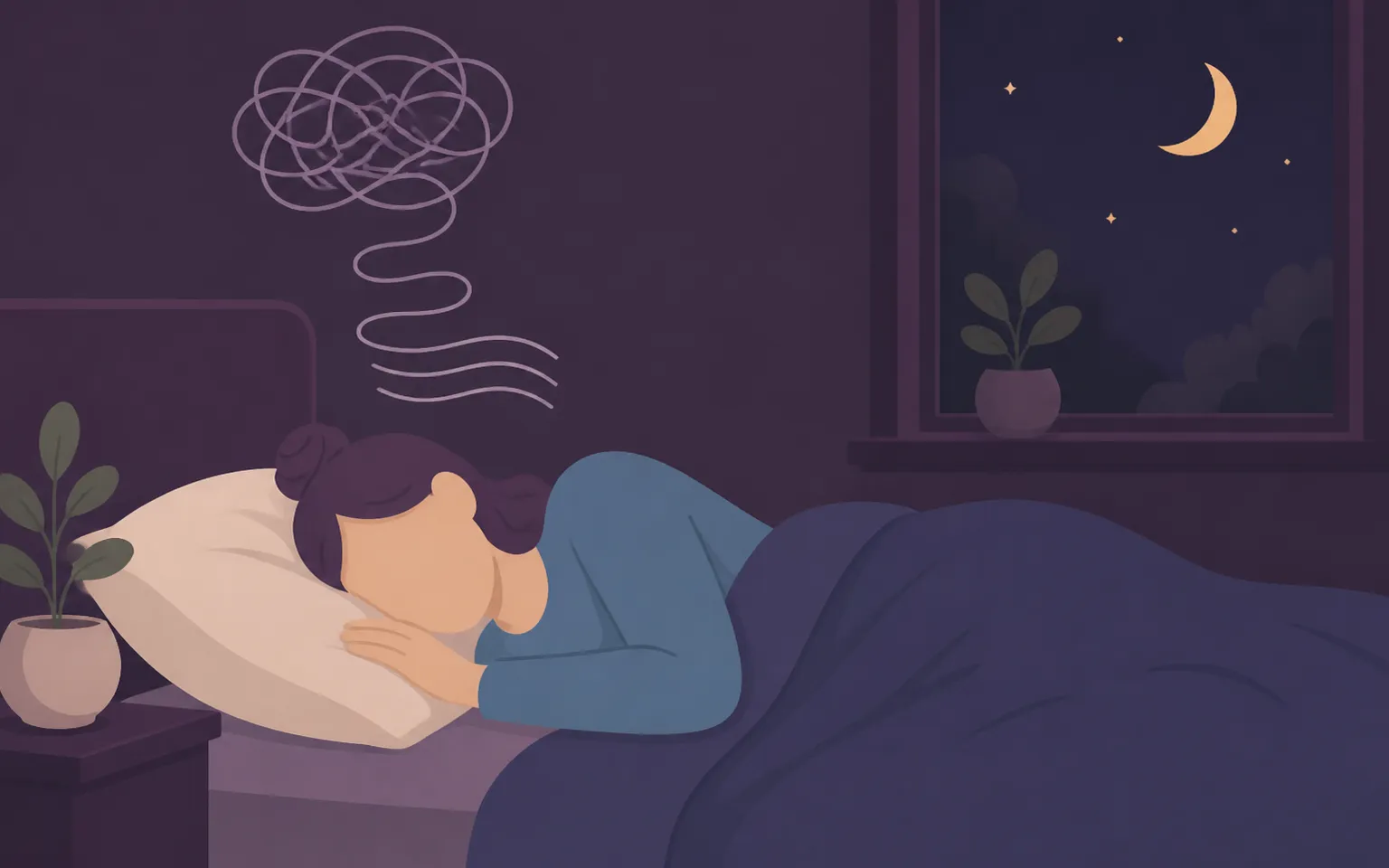
The lights are off, the day is over, and your mind chooses this moment to review everything. An unanswered message. Something you said in a meeting four days ago. A list of tomorrow’s tasks, assembled in the dark with no way to write any of it down.
Then the second layer arrives: you check the time, calculate how few hours are left, and begin trying to fall asleep. That effort is usually what keeps you awake.
Mindfulness helps here, but not in the way most articles suggest. It is not a technique for switching the mind off. It is a way of lying in the dark that stops making things worse.
Why the mind speeds up at night
Bedtime is often the first moment all day with no input. No screen, no conversation, no task. Everything that was postponed while you were busy now has room, and it takes it.
There is a physical layer too. If your evening was rushed, your body may still be running slightly elevated, and a nervous system that is still switched on interprets stillness as an opportunity to think rather than a signal to rest.
None of this is a personal defect. A mind that gets loud in a quiet room is doing exactly what minds do. It is worth knowing that, because most of the distress of lying awake comes from believing something has gone wrong with you.
The trap of trying to fall asleep
Here is the part that matters most, and the part most bedtime advice skips.
Sleep is not something you can do. It arrives when conditions allow, in the same way that a bruise heals or hunger appears—you can set up the circumstances, but you cannot perform the act. And the moment you start trying, you introduce effort, monitoring, and a result you are checking for. Effort is arousal. Monitoring is arousal. Both are the opposite of what sleep needs.
This is why the practices below are deliberately not framed as ways to fall asleep faster. If you use them as techniques to force an outcome, they will stop working, because you will spend the whole time checking whether they are working.
The aim is different and much more achievable: rest instead of sleep. Lying still in the dark, warm, not doing anything, is genuinely restorative even when you are awake for it. If you can let the night be about that, you remove the pressure—and once the pressure is gone, sleep tends to show up on its own.
A practice for lying awake
No timer, no counting how long it takes, no checking the clock.
- Give up on sleeping for now. Say it plainly to yourself: I am not going to sleep right now, I am going to rest. This is not resignation. It removes the thing generating pressure.
- Feel the weight. Notice where your body meets the mattress—heels, hips, shoulders, head. Let each area be heavier than it needs to be. Weight is a useful anchor because it requires no effort to sense.
- Let the breath be as it is. Do not lengthen or deepen it. Just follow the movement in your belly or chest. Trying to breathe correctly is another form of trying to sleep.
- Name the thoughts, briefly. When your mind starts up—and it will—label it in one word: planning, replaying, worrying. Then return to the weight of your body. The single word marks the thought without starting a conversation with it.
- Expect to do this many times. Twenty returns is a normal night, not a failed one. The returning is the practice.
A slow attention pass through the body suits this position particularly well. If you want a longer version of step two, move through the body in order rather than sensing it all at once—feet, calves, thighs, hips, lower back, belly, hands, arms, shoulders, jaw—giving each area two or three breaths before moving on. Reaching the jaw without having fallen asleep is not a failure; you have spent ten minutes resting. That sequence is a body scan, and the full practice covers what to do when an area feels numb, uncomfortable, or refuses to hold your attention.
The hour before bed does more than the technique
Practices at midnight are damage control. The evening is where the leverage is.
- Stop the feed earlier than feels necessary. Scrolling in bed is the most reliable way to arrive at the pillow with an activated mind, and the content is usually the problem more than the light. Our guide to breaking the doomscrolling cycle covers why the loop is so hard to exit.
- Write tomorrow down. Two minutes with paper, listing what is unfinished, gives the mind evidence that it does not need to hold everything. Many people find this single habit does more than any breathing exercise.
- Let the light drop. Dimmer lamps in the last hour, rather than overhead lighting until the second you get into bed.
- Watch the caffeine window. Caffeine has a half-life of roughly five to six hours, so an afternoon coffee is still partly present at bedtime.
- Keep wake-up time steady. Consistent rising times anchor sleep timing more effectively than consistent bedtimes do—including at weekends. If you are building a morning anyway, our ten-minute mindful morning routine is a gentle place to put that anchor.
- Unwind on purpose. If your days run hot, the evening is not the place to start settling. Managing stress with mindfulness deals with the daytime side of this.
What mindfulness can and cannot do for sleep
Being straightforward about this is more useful than optimism.
What it can do. Mindfulness practice reliably reduces the distress of lying awake, which is a large part of what makes a bad night bad. It also weakens the cycle in which worrying about sleep prevents sleep. Mindfulness-based programs have been studied for insomnia and show modest improvements in sleep quality for some people, and the National Center for Complementary and Integrative Health summarizes that evidence without overselling it.
What it cannot do. It is not a treatment for chronic insomnia. If you have had trouble sleeping at least three nights a week for three months or more, the first-line treatment is cognitive behavioral therapy for insomnia—a short, structured, non-drug program with strong evidence behind it. The National Heart, Lung, and Blood Institute explains what it involves. Mindfulness can sit alongside that; it is not a replacement for it, and choosing it instead may cost you months.
It also cannot fix a sleep problem with a physical cause, which is the next section.
When to talk to a doctor
Some sleep problems are not about a busy mind, and no amount of practice will resolve them. Speak with a qualified professional if:
- difficulty falling or staying asleep has continued for three months or more,
- you are exhausted during the day despite spending enough hours in bed,
- someone has told you that you snore loudly, gasp, or stop breathing in your sleep—possible signs of sleep apnea, which needs medical assessment,
- you have persistent restlessness or crawling sensations in your legs at night,
- poor sleep is accompanied by low mood, anxiety, or loss of interest in things you normally enjoy, or
- you are relying on alcohol or over-the-counter sleep aids to get to sleep.
Sleep and mental health run in both directions, and each makes the other harder. The National Institute of Mental Health has guidance on when and how to seek support.
A different measure of a good night
If you judge tonight by whether you fell asleep quickly, you have made sleep into a test you can fail while lying perfectly still.
Try a different question. Were you kinder to yourself in the dark? Did you spend less of the night arguing with being awake? Did you rest, even without sleeping?
Those are within your reach, every night, regardless of what your sleep does. And they turn out to be the conditions under which sleep is most likely to come anyway.