Box Breathing: How to Use the 4-4-4-4 Technique
A step-by-step guide to box breathing—the 4-4-4-4 count that steadies your body in about a minute—plus when it helps and when to choose something else.
There is a moment before a difficult conversation, or after an email you did not expect, when your body moves faster than your thinking. Your chest tightens, your breath goes shallow and high, and every useful idea you had leaves the room.
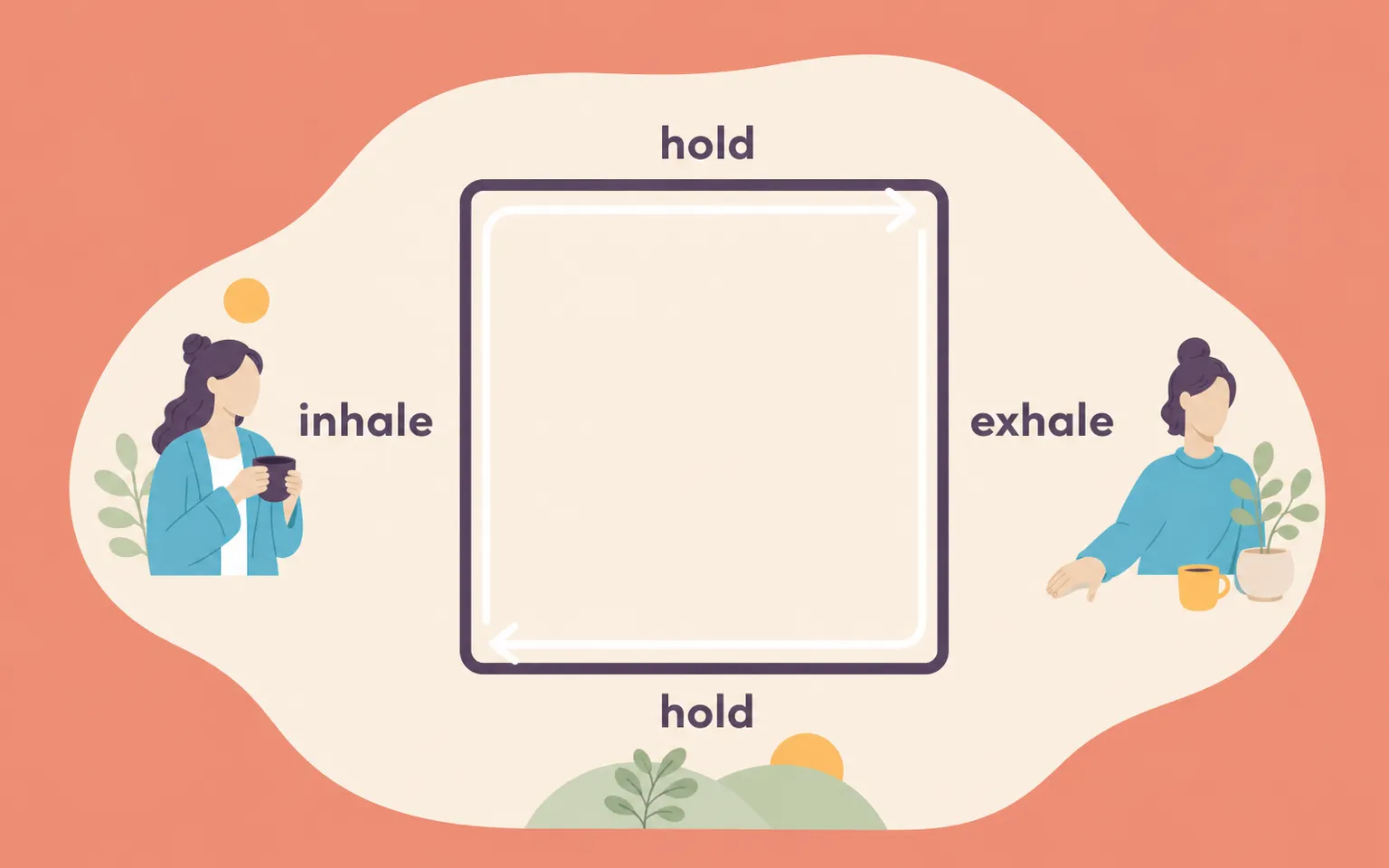
Box breathing is a way to interrupt that. You breathe in for four counts, hold for four, breathe out for four, hold for four, and repeat. It takes about a minute, requires nothing, and can be done with your eyes open in a room full of people.
What is box breathing?
Box breathing is a breathing exercise with four equal parts: inhale, hold, exhale, hold, each for the same count. It is also called square breathing or four-square breathing. The equal counts slow your breathing rate and give your attention a simple structure to rest on, which is why it is often used before stressful moments.
The name comes from the shape. Four sides of equal length, and you trace them with your breath.
How to do box breathing
You can sit, stand, or lie down. An upright posture makes the exhale easier, but nothing here depends on sitting a particular way.
- Exhale first. Let the air you are holding go before you begin. Most people who feel tense are already holding a half-full chest, and starting with an inhale on top of that feels like effort.
- Inhale through your nose for four counts. Slowly, and no fuller than comfortable. This is not a deep breath—it is a slow one.
- Hold for four counts. Keep your throat and jaw loose. You are pausing, not bracing.
- Exhale through your nose or mouth for four counts. Let it be an unhurried release rather than a push.
- Hold for four counts. Empty, and still relaxed.
- Repeat four times. That is roughly sixty-four seconds of breathing, which is usually enough to notice a change.
Count at whatever pace feels natural. A count of four does not need to be four seconds exactly, and chasing precision defeats the purpose.
If four counts feels too long
Then use three, or two. Straining for a longer count raises tension instead of lowering it, which is the opposite of what you came for.
A useful variation is to keep the inhale and exhale equal but shorten the holds—in for four, hold for two, out for four, hold for two. You keep the steadying rhythm and lose the part that most people find uncomfortable at first.
Why a slow, even breath settles the body
Breathing is one of the few automatic functions you can take over deliberately, which makes it a practical entry point when you cannot think your way to calm.
Slow breathing—roughly six breaths a minute or fewer, which is about where box breathing lands—shifts the balance of the nervous system toward the branch responsible for rest rather than alarm. You can sometimes feel this as a slight loosening in the shoulders or a longer gap between thoughts.
Two honest notes about the evidence. First, breathing exercises are well established as a relaxation technique, and the National Center for Complementary and Integrative Health treats them that way, but the research on any single named pattern is thinner than the internet suggests. Box breathing has not been shown to be superior to other slow-breathing methods. Second, box breathing is often described as a military technique, which is an origin story rather than evidence—it became popular through that association, not because of a study.
What this means in practice: the specific count matters less than the slowness and the evenness. If a different rhythm suits you better, it is not a worse technique.
When box breathing helps most
It is well suited to short, sharp moments rather than long-running difficulty:
- the two minutes before a presentation, interview, or hard conversation,
- sitting in the car before going into a building,
- after an upsetting message, before replying,
- when you notice your breathing has gone high and quick,
- in a waiting room, where you want something invisible to the people around you.
For a broader sense of what steadier attention does over weeks rather than minutes, our introduction to what mindfulness actually is is a better starting point. If the pressure you are dealing with is ongoing rather than acute, managing stress with mindfulness covers ground this exercise cannot.
When to use something else
Breath-focused exercises are not right for everyone, and this deserves more prominence than it usually gets.
If holding your breath makes you anxious. For some people—particularly those who experience panic attacks—paying close attention to breathing increases fear rather than reducing it, because the sensations themselves are what feel alarming. Breath holds can make that worse. This is a known effect, not a personal failing. If it happens, use an anchor outside the body instead: the five-minute mindful reset leans on the senses rather than the breath, and mindful walking leans on movement. If panic attacks are a regular experience, the National Institute of Mental Health has plain-language information on what helps.
If you feel dizzy or light-headed. Stop, breathe normally, and let it pass. This usually means the breaths were too deep rather than too slow. Volume is the thing to reduce.
If you have a respiratory or cardiac condition, or you are pregnant. Breath holds are worth checking with a clinician first. Simple slow breathing without holds is generally the gentler option.
Nobody should be pushing through discomfort here. A breathing exercise that feels like effort is not working.
Three mistakes that make it feel worse
Breathing too big. The instruction is slow, not deep. Filling your lungs on each of four rounds tends to leave people light-headed and convinced the technique is not for them.
Tensing during the holds. Watch the jaw, the shoulders, and the floor of the mouth. A hold should feel like a pause in a sentence, not like keeping a door shut.
Expecting it to remove the feeling. Box breathing does not delete anxiety, and treating that as the goal turns one minute of breathing into one more thing you are failing at. What it reliably does is create a gap—a few seconds in which you can choose your next move rather than react to it. That gap is the point.
A small thing that is available everywhere
Most mindfulness practices ask for a few minutes and some willingness. This one asks for less, which is exactly why it is worth having.
You will not remember it the first several times you need it. Then one day you will be standing somewhere with your chest tight, and you will exhale and start counting, and the moment will be a little more yours than it was.
That is not a small result for sixty seconds of work.